

Direct Mail for Sales Outreach (B2B): Targeting, Sequencing, and Offers That Work
A modern B2B guide to using direct mail in outbound and ABM: who to send to, where it fits in your cadence, what to offer, and how to track impact.
Introduction
Introduction: mail isn’t a channel — it’s a wedge
B2B outbound usually fails for predictable reasons:
- too broad
- too generic
- too frequent
- impossible to differentiate
Direct mail is one of the few tactics that can create a clean pattern interrupt—but only if you treat it like a high-intent tool, not a broadcast channel.
This post covers:
- which accounts and contacts should receive mail
- where mail fits in a modern outbound cadence
- offer ideas that don’t feel like bribery
- how to measure impact without relying on last-click fantasies
If you want a broader intro to handwritten notes, start here: Handwritten Notes for Business: The Complete B2B Guide.
Who should receive direct mail (a simple targeting model)
Start with a tiering model based on value and intent.
Tier 1: high-value, high-fit accounts
Send handwritten notes or letters when:
- intent is present (engagement, stage movement, event interaction)
- the buyer is on your shortlist (decision maker / champion)
Tier 2: medium-value, high-fit accounts
Use hybrid:
- printed reach touches for awareness
- handwritten only after engagement
Tier 3: long-tail accounts
Skip mail unless:
- they show clear intent
- you have verified address quality
For deeper list-building tactics, see: Finding great data for direct mail campaigns.
Where mail fits in an outbound cadence (examples)
Mail works best as a multiplier for your other channels (email, calls, ads).
Cadence A: warm ABM accounts (post-engagement)
- Day 0: website engagement threshold hit
- Day 1: email (short, relevant)
- Day 3: handwritten note (reference the initiative)
- Day 6: follow-up email (“did the note land?”)
- Day 9: call + voicemail
Cadence B: post-demo acceleration
- Day 0: demo completed
- Day 1: recap email with next steps
- Day 2–3: handwritten note (one key takeaway + next step)
- Day 7: stakeholder follow-up email (“happy to include {{stakeholder}}”)
Cadence C: late-stage stall
- Day 0: opp stalled for 14–21 days
- Day 1: short “unstick” email
- Day 2: handwritten note from AE or exec sponsor
- Day 5: call + calendar invite to re-align
For a cadence-focused deep dive, see: Using Direct Mail with Multi-Touch Campaigns & Optimizing ABM Cadence.
Offers that work in B2B (without feeling like a bribe)
The best “offers” in B2B outbound are not gifts. They’re useful value.
1) A teardown
“I’ll send a 1-page teardown of your {{motion}} and 3 improvements.”
2) A short plan
“Here’s a simple 2–3 step plan to hit {{outcome}}.”
3) A benchmark
“Here’s how teams like {{peer_group}} measure {{metric}} and what good looks like.”
4) A workshop invite
“We’re hosting a short roundtable on {{topic}}—happy to reserve a seat.”
5) An executive summary
“If helpful, I’ll send a concise exec summary of what we’re seeing in {{category}}.”
If you do use gifts, align with policy:
- confirm recipient gift rules
- keep value modest
- never make the gift the core reason to reply
What to write (templates)
Template: outbound note to a high-fit account
Hi {{first_name}},
I’m reaching out because {{why_you}} and thought this might be relevant.
We’ve helped teams like {{peer_group}} improve {{outcome}} by {{approach}}.
If useful, I can share a quick 2–3 step plan — want me to send it over?
— {{sender_name}}

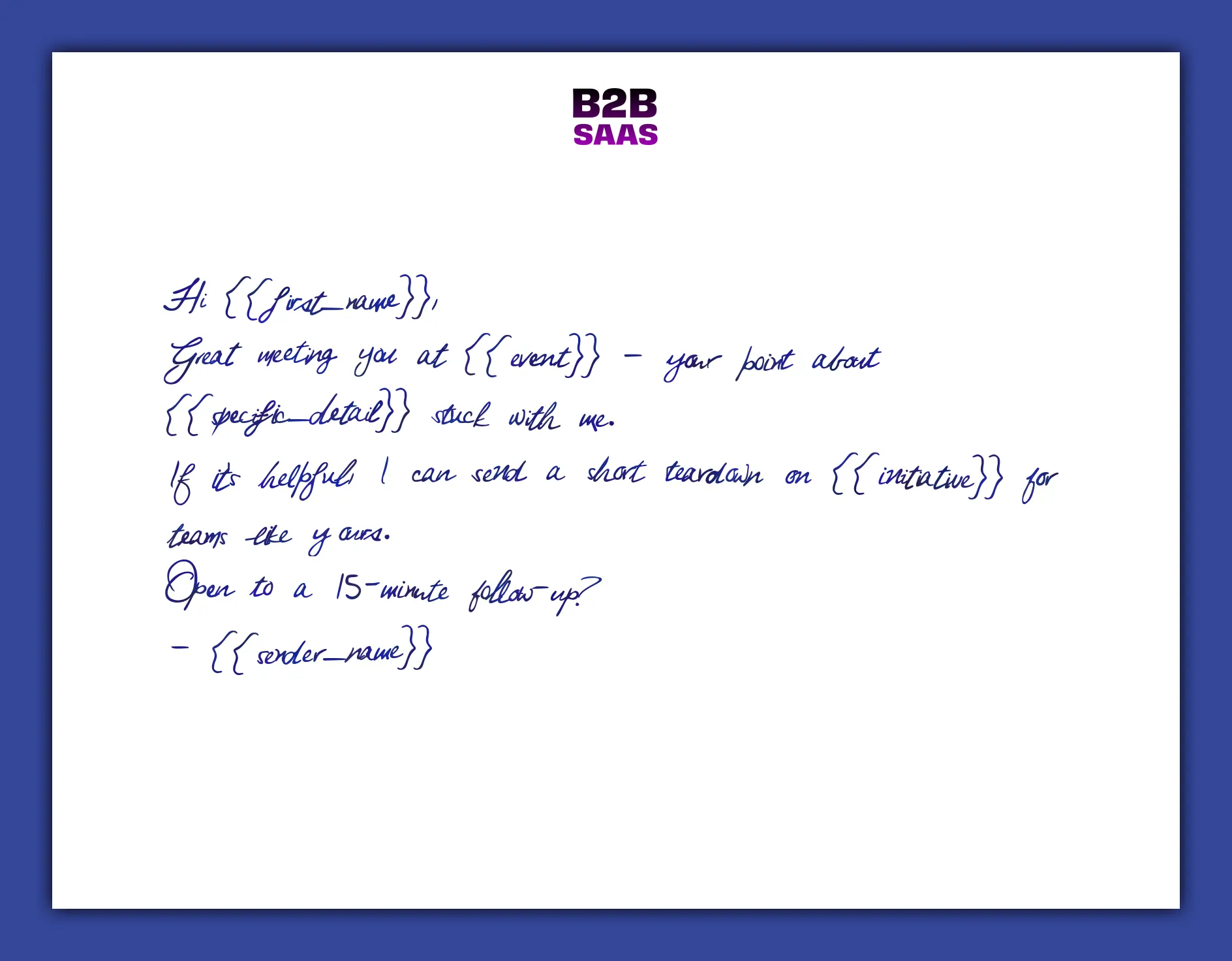
Template: post-event follow-up
Hi {{first_name}},
Great meeting you at {{event}} — your point about {{specific_detail}} stuck with me.
If it’s helpful, I can send a short teardown on {{initiative}} for teams like yours.
Open to a 15-minute follow-up?
— {{sender_name}}
For thank-you phrasing and scenarios, see: Business Thank You Notes: Templates for Clients, Prospects & Partners.
Measurement: what to track in sales outreach
Don’t judge direct mail solely on “QR scans.”
Track:
- reply rate lift (in targeted segments)
- meetings booked
- opportunity creation rate
- stage progression speed
- win rate (for late-stage motions)
At minimum:
- log mail sends in CRM (date + segment)
- use trackable URLs/QRs for any CTA
For measurement mechanics, see: How to track direct mail marketing campaigns.
Common mistakes
- Sending to broad lists (“spray and pray”)
- Writing generic notes (“checking in”)
- No trigger, no context, no “why now”
- No instrumentation
Conclusion
Direct mail works in B2B sales when it’s used like a precision tool:
- tight targeting
- signal-based timing
- short, specific copy
- measured against real outcomes (meetings, pipeline, velocity)
Want help designing a direct mail motion for outbound or ABM? Book a campaign consult


